Understanding the energy parameters behind HIFU therapy is the foundation of safe, consistent, and effective treatment. Whether used for facial lifting or body contouring, precise control of frequency, intensity, and pulse duration determines how ultrasound energy interacts with the skin and subcutaneous layers.
This guide breaks down how HIFU works, the science behind its settings, and how to adjust energy parameters for different treatment zones and patient profiles.
How Does HIFU Work?
HIFU (High-Intensity Focused Ultrasound) uses concentrated ultrasound waves to deliver controlled thermal energy deep beneath the skin surface. Instead of heating the surface, the energy converges at specific depths—1.5 mm, 3.0 mm, 4.5 mm, and even 8–13 mm for body treatments.
At the focal point, tissue temperature briefly reaches 60–70 °C, creating micro-thermal coagulation zones. These tiny controlled injuries trigger the body’s natural wound-healing response, which leads to:
- Immediate collagen contraction (instant firming).
- New collagen and elastin production over several weeks.
- Gradual tightening of skin and underlying connective tissue.
This process rejuvenates the face and body naturally without injections, surgery, or downtime.
The Three Core Energy Parameters
Frequency (MHz)
Frequency determines how deep the ultrasound waves penetrate. It’s measured in megahertz (MHz)—the number of sound wave cycles per second.
- High frequencies (7–10 MHz) deliver energy more superficially (epidermis and upper dermis).
- Low frequencies (3–4 MHz) penetrate deeper layers (SMAS or fat).
Each treatment cartridge operates at a fixed frequency tuned to its focal depth.
|
Frequency |
Penetration Depth |
Clinical Application |
|
10 MHz |
1.5 mm |
Eye area, forehead, fine wrinkles |
|
7 MHz |
3.0 mm |
Mid-dermis tightening |
|
4 MHz |
4.5 mm |
SMAS lift (face, jawline, neck) |
|
2–3 MHz |
8–13 mm |
Body contouring, cellulite reduction |
Intensity (Energy Level / Joules)
Intensity controls how much energy is delivered per shot. It’s measured in joules (J) or energy per line (J/cm²).
- Lower intensities (0.1–0.3 J) are used near delicate areas such as the eyes or temples.
- Moderate intensities (0.4–0.8 J) suit most facial tightening applications.
- Higher intensities (0.9–1.5 J) target thicker tissues like jawline, neck, or abdomen.
Too little energy may fail to stimulate collagen effectively; too much risks discomfort or heat buildup. Proper calibration ensures each pulse delivers uniform heating without surface burns.
Pulse Duration (ms)
Pulse duration—also called dwell time—refers to how long each pulse remains active at the target tissue. It’s typically measured in milliseconds (ms).
Shorter pulses (10–20 ms) generate quick heat bursts for precise collagen stimulation, while longer pulses (up to 100 ms) allow more diffusion for body sculpting.
The balance between pulse duration and energy intensity defines how the heat spreads within tissue:
- Short + high-intensity: concentrated heat for focal tightening.
- Long + low-intensity: gentle bulk heating for contouring.
The skin consists of multiple layers, each reacting differently to ultrasound energy:
- Epidermis (0–1 mm): protected by cooling gel, not directly heated.
- Dermis (1.5–3 mm): collagen fibers shrink and thicken.
- SMAS layer (4.5 mm): contracts to lift facial structure.
- Subcutaneous fat (8–13 mm): mild lipolysis and skin tightening in body treatments.
This layered heating approach enables HIFU to rejuvenate the entire facial structure, not just the surface—explaining why HIFU facial lifting looks so natural.
How Long Does It Take HIFU to Work?
Many patients notice a subtle lift immediately after treatment, as collagen fibers contract. However, the full effect develops gradually as new collagen matures.
|
Timeline |
What Happens |
|
Immediately |
Mild tightening and glow. |
|
2–4 weeks |
New collagen begins forming; skin feels firmer. |
|
8–12 weeks |
Peak remodeling; contours appear lifted. |
|
6–18 months |
Results maintained; maintenance may be needed yearly. |
Clinics should inform clients that HIFU is a biological process, not an instant fix. Explaining this timeline helps manage expectations and improves satisfaction.
HIFU Treatment Parameters by Area
Different skin zones require unique combinations of frequency, energy, and pulse duration.
|
Treatment Area |
Depth (mm) |
Frequency (MHz) |
Typical Energy Range |
Pulse Mode |
|
Forehead / Eyes |
1.5–3.0 |
7–10 |
0.1–0.3 J |
Short, gentle |
|
Cheeks / Mid-face |
3.0–4.5 |
4–7 |
0.4–0.8 J |
Medium dwell |
|
Jawline / Chin |
4.5 |
4 |
0.6–1.2 J |
Longer dwell for lift |
|
Neck |
3.0–4.5 |
4–7 |
0.4–0.7 J |
Gentle pass, longer cooling |
|
Abdomen / Arms |
8–13 |
2–3 |
0.8–1.5 J |
Long pulse, body mode |
Clinicians often combine multiple depths per session for a multi-layer treatment—achieving both superficial smoothing and deep structural tightening.
How Quickly Does HIFU Work Compared to Other Treatments?
Compared to other non-invasive options:
|
Technology |
Mechanism |
Visible Results |
Longevity |
|
HIFU |
Focused ultrasound reaches SMAS layer |
4–12 weeks |
12–18 months |
|
Radiofrequency (RF) |
Surface dermal heating |
2–4 weeks |
6–9 months |
|
Microcurrent |
Muscle stimulation |
Instant (temporary) |
24–48 hours |
|
Laser resurfacing |
Surface ablation |
2–3 weeks |
6–12 months |
HIFU’s ability to reach deeper tissues gives it longer-lasting results than RF or laser—while remaining entirely non-invasive.
How to Adjust Parameters Safely
Personalized parameter setting is crucial for comfort and effectiveness.
Factors to Consider:
- Skin thickness: thinner skin requires higher frequency (shallower penetration).
- Pain tolerance: start at lower intensity and increase gradually.
- Treatment area: delicate areas (eyes, forehead) need shorter pulse durations.
- Patient goals: lifting vs. tightening vs. contouring.
Always perform a test line to check tolerance before proceeding with full coverage.
Common Energy Settings in Clinics
|
Parameter |
Face (Avg.) |
Body (Avg.) |
|
Frequency |
4–10 MHz |
2–4 MHz |
|
Intensity |
0.2–1.2 J |
0.8–1.5 J |
|
Pulse duration |
10–50 ms |
50–100 ms |
|
Shot spacing |
1–1.5 mm |
1.5–2 mm |
|
Cartridges |
1.5, 3.0, 4.5 mm |
8, 10, 13 mm |
These ranges are for educational guidance; actual clinical parameters depend on machine calibration and skin response.
What Clients Feel During Treatment

During a session, clients typically experience:
- Warmth and tingling under the skin.
- Brief prickling sensations at energy focal points.
- No burning or surface damage when performed correctly.
Explaining these sensations before treatment helps reduce anxiety and improves cooperation during energy delivery.
Post-Treatment Recovery
HIFU is celebrated for minimal downtime.
Immediately after: mild redness that resolves within a few hours.
Next 1–3 days: slight tenderness, especially around the jawline.
No peeling,: bruising, or scabbing should occur—unlike ablative lasers.
Patients can resume work and makeup the same day, making HIFU one of the most convenient rejuvenation procedures.
Combining Frequencies for Advanced Results

Modern multi-cartridge systems allow simultaneous use of multiple depths in one session:
- 1.5 mm + 3.0 mm: texture smoothing and pore tightening.
- 3.0 mm + 4.5 mm: comprehensive lifting of mid-face and jawline.
- 4.5 mm + 8 mm: face-neck-body integration for contouring.
Layering different frequencies enhances collagen stimulation while keeping energy distributed safely across depths.
Troubleshooting & Common Mistakes
|
Issue |
Likely Cause |
Solution |
|
Uneven tightening |
Inconsistent energy overlap |
Maintain 1 mm shot spacing |
|
Discomfort or bruising |
Excessive intensity or poor gel application |
Reduce energy, apply more gel |
|
Limited results |
Too low energy or few lines |
Increase shot count and ensure full coverage |
|
Temporary swelling |
Normal response |
Apply cold compress; resolves in 24 h |
Consistent energy mapping and even shot distribution are key to predictable results.
How HIFU Parameters Differ for Face vs. Body
Facial HIFU
- Uses higher frequency (7–10 MHz) for precision.
- Targets SMAS for lifting.
- Average duration: 45–60 minutes.
Body HIFU
- Uses lower frequency (2–4 MHz) for deeper penetration.
- Focuses on subcutaneous fat and loose skin.
- Average duration: 60–90 minutes per area.
Both share the same principle—thermal coagulation—but differ in penetration and energy distribution.
Educating Clients on “How Long Does It Take HIFU to Work”
To manage expectations, clinics should clearly outline progress timelines:
- Immediate lift: visible tightening from collagen contraction.
- 1 month: subtle texture improvement.
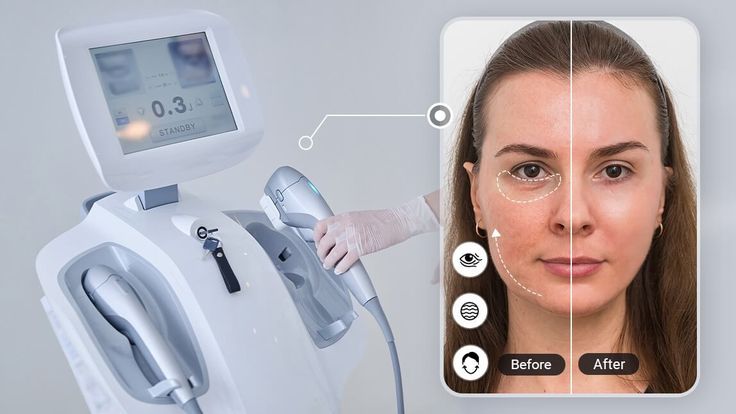
- 2–3 months: full lifting effect visible in before-and-after photos.
- 6–12 months: gradual decline; recommend yearly maintenance.
Clients appreciate transparency about this biological healing process—it reinforces trust and promotes follow-up visits.
Purpose of Understanding Energy Parameters
Clinicians who master frequency, intensity, and pulse duration can:
- Deliver personalized treatments for different skin types.
- Prevent overtreatment or discomfort.
- Optimize results for both face and body applications.
- Build patient confidence with precise, science-based protocols.
Material & Technical Structure of Professional HIFU Systems
Professional-grade HIFU systems combine acoustic precision and robust engineering.
Core Components:
- Ultrasound generator: converts electrical power to stable acoustic waves.
- Transducers (cartridges): multiple depths (1.5–13 mm) for customized treatments.
- Smart interface: pre-set energy curves and safety monitoring.
- Cooling circuits: prevent overheating and ensure consistent output.
- Durable casing: aluminum or polymer build for ergonomic handling.
Understanding this structure helps operators maintain long-term reliability and accuracy.
Key Takeaways
- HIFU energy depends on three critical factors: frequency, intensity, and pulse duration.
- Higher frequencies target superficial layers; lower frequencies reach deeper tissue.
- Collagen regeneration takes 8–12 weeks—results are gradual but lasting.
- Adjust settings according to skin thickness and sensitivity.
- Always explain the biological timeline so clients know how long HIFU takes to work and what to expect.
By combining precise parameter control with patient education, clinics can ensure safe, predictable, and highly satisfying outcomes.